Tables with a contract
Bronze, silver and gold layers that actually mean something.
Databricks lakehouse
Databricks earns its place when the data gets big or the workload gets scientific: log-level programmatic feeds, event streams, and models trained on the same data that feeds reporting. We build lakehouse pipelines on Delta Lake and keep them cheap enough to run daily.
What you get
Bronze, silver and gold layers that actually mean something.
DSP feeds, event streams and clickstream at volume.
MLflow-tracked models on the same platform as reporting.
Cluster policies and job configuration tuned to the workload.
The problem
Databricks is powerful enough to let a team make an expensive mess. Raw files land in cloud storage with no table format, so nothing is queryable without tribal knowledge. Notebooks become production pipelines with no version control, tests or scheduling. Clusters are provisioned generously and never right-sized. Six months later there is a lot of data, a large bill, and no reliable reporting layer on top of it.
What we implement on Databricks
How we work
Establish the table format and medallion layout before adding pipelines
Move production logic out of notebooks into version-controlled, tested jobs
Build the gold reporting layer and connect BI to it, not to raw data
Right-size clusters and set policies, then review real cost after a month
Typical stack
Proof from our work

Tinuiti manages advertising across Amazon, Walmart, TikTok, Instacart, and Criteo, but their teams were stuck with fragmented reporting and heavy manual work. TechEsthete rebuilt their data and automation backbone from scratch, creating a multi-source ETL pipeline and a unified BI framework that pulls every marketplace into one dashboard that stays current through the day.
Read the case study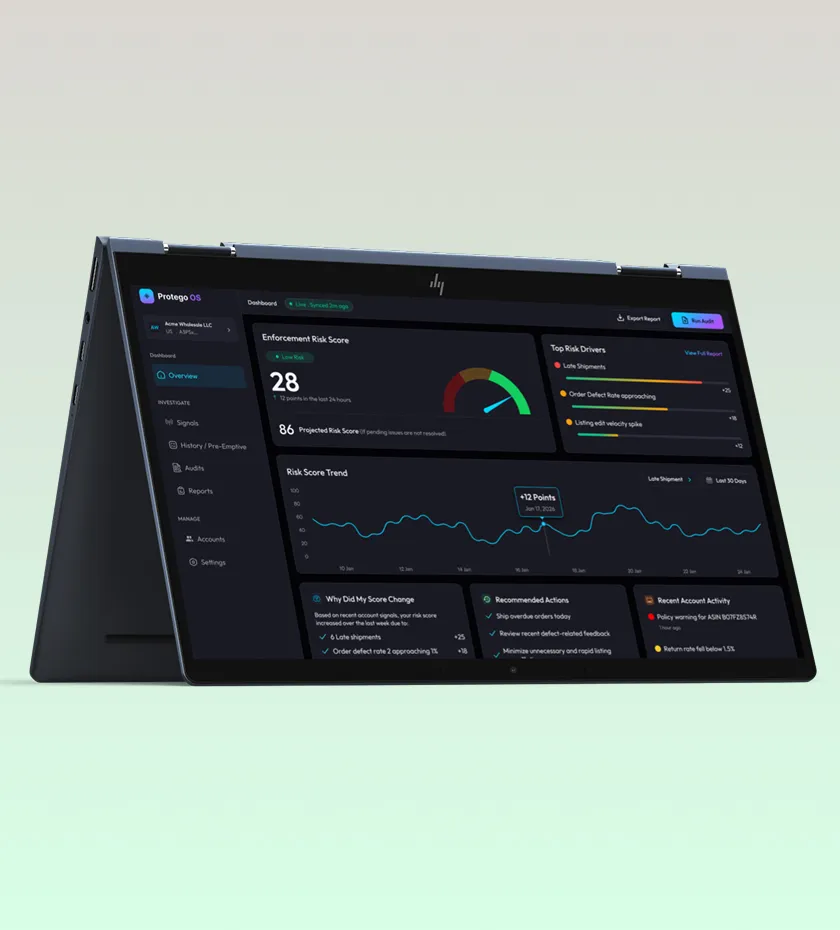
We were engaged to architect and build the complete backend data infrastructure behind Protego: SP-API integration, report ingestion, risk-signal normalization and the scoring pipeline.
Read the case studyFAQ
For most marketing reporting, Snowflake or BigQuery is simpler and cheaper, and we will say so. Databricks earns its complexity when you are processing log-level or clickstream data at genuine volume, need Spark for transformations a warehouse handles poorly, or want ML training and feature engineering on the same platform as reporting. Choosing it for ordinary ad reporting is overbuying.
Commonly, yes, and it is often the right answer. Databricks handles heavy processing and ML, then publishes modeled gold tables to Snowflake or BigQuery, where BI tools and analysts are already productive. Each does what it is good at.
It gives every table an explicit contract: bronze is raw and immutable, silver is cleaned and conformed, gold is business-ready. Without that separation, teams transform in place, lose the ability to reprocess history, and cannot tell which tables are safe to build on.
Yes, and we often do. dbt handles the SQL transformation layers well and keeps modeling logic portable and reviewable, while Spark jobs handle what SQL cannot express efficiently.
Related
DSP and log-level ingestion, cross-screen reach and CTV incrementality.
Learn moreMulti-tenant access, dbt modeling and a predictable credit bill.
Learn moredbt on Snowflake or BigQuery: every ad platform modeled, tested and documented.
Learn moreTell us your data volumes and workloads and we will tell you honestly whether Databricks is the right call.