A full inventory
Every pipeline, source and report, including the undocumented ones.
Data maturity audit
A structured review of the data infrastructure you already have: what works, what is quietly broken, what it costs, and what to fix in what order. You get a written assessment and a prioritized roadmap, whoever ends up doing the work.
What you get
Every pipeline, source and report, including the undocumented ones.
Silent data quality issues and single points of failure.
Warehouse compute, connector licenses and analyst hours on manual work.
The thing that unlocks budget.
The problem
Teams know something is wrong with their data. Reporting is late, numbers get questioned, and every new request takes weeks. What nobody can state precisely is where the failure is: ingestion, modeling, the BI layer or process. So remediation gets guessed at, often by buying a tool that addresses a symptom. Meanwhile the risks that matter, such as a single undocumented pipeline one person understands, stay invisible until that person leaves.
What the audit covers
How we work
Interview the people who actually run and consume the data, not only the sponsor
Get read access to the warehouse, orchestration and repos, and inspect the real state
Trace two or three important metrics from source to dashboard and find where they diverge
Present findings, take challenge from your team, and deliver the final written roadmap
What we use
Related work
We rebuilt the ETL, warehouse and automation layer across Amazon, Walmart, TikTok, Instacart and Criteo.
Read the case study
We built ETL pipelines into one data model and one dashboard for Amazon, Walmart and Instacart campaigns.
Read the case study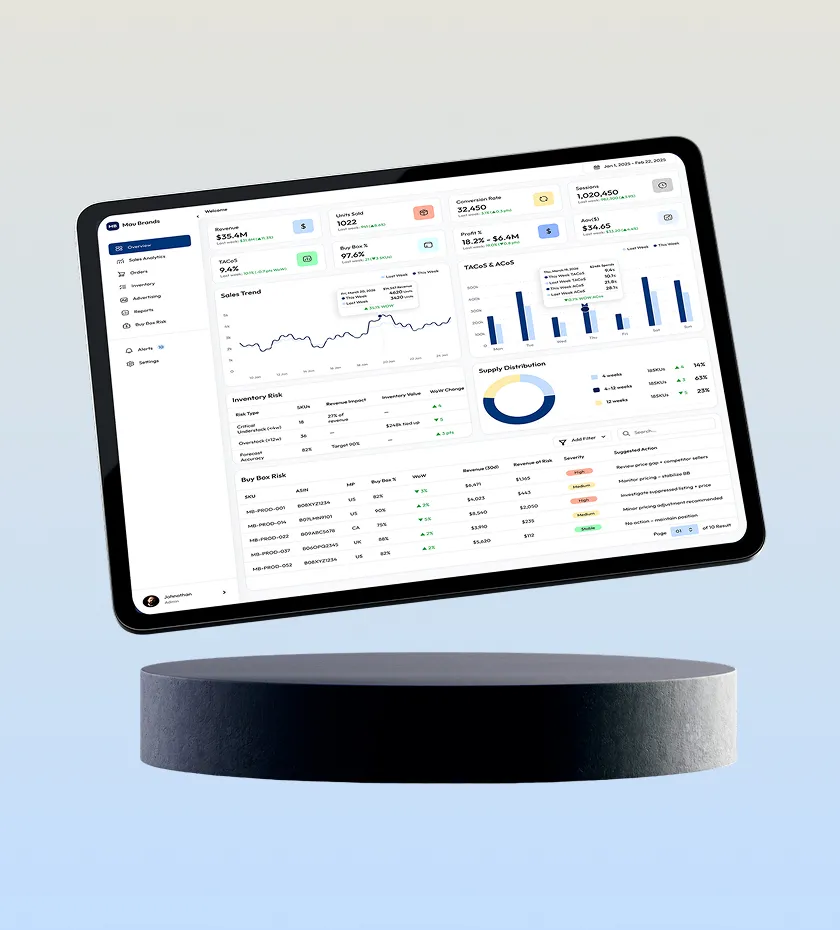
We built Mau Brands' Amazon analytics platform: sales, inventory, ads and pricing in one view.
Read the case studyFAQ
Read-only access to the warehouse, orchestration tool and transformation repo, plus time with two or three people who work with the data daily. We can work from documentation and interviews alone if access is genuinely blocked, but the findings will be weaker and we will say so.
Usually, for two reasons. First, the audit turns known problems into a prioritized, costed sequence, which is what unlocks budget. Second, it consistently surfaces things nobody knew, most often silent data quality issues and single points of failure.
A written report covering current state, findings ranked by severity, and a sequenced roadmap with effort estimates, plus a working session to walk through it. It is written to be handed to your team or another vendor without translation.
A vendor assessment exists to justify a purchase, and the conclusion is known before it starts. This one can conclude that your stack is fine and the problem is process, which has been the outcome more than once.
Related
Freshness, volume and schema drift alerts, plus reconciliation to platform figures.
Learn moreThree-year cost modeled at your real volumes, vendors evaluated, lock-in priced.
Learn morePipelines, ad platform integrations, warehouses and monitoring.
Learn moreTell us roughly what your stack looks like and we will scope the audit and the access it needs.